what is the term to describe buying items today rather than saving the money?

China M2 money supply vs USA M2 money supply

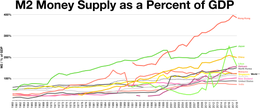
In macroeconomics, the money supply (or money stock) refers to the total book of money held past the public at a particular signal in time in an economic system. At that place are several ways to define "coin", just standard measures ordinarily include currency in apportionment and need deposits (depositors' easily accessed assets on the books of fiscal institutions).[one] [2] The central bank of each state may utilize a definition of what constitutes coin for its purposes.
Money supply data is recorded and published, unremarkably by the authorities or the fundamental banking concern of the country. Public and private sector analysts monitor changes in the money supply because of the belief that such changes affect the cost levels of securities, inflation, the exchange rates, and the business bicycle.[three]
The relationship between money and prices has historically been associated with the quantity theory of money. There is strong empirical evidence of a direct human relationship betwixt the growth of the money supply and long-term price inflation, at least for rapid increases in the amount of money in the economy.[ commendation needed ] For example, a country such every bit Republic of zimbabwe which saw extremely rapid increases in its money supply also saw extremely rapid increases in prices (hyperinflation). This is ane reason for the reliance on monetary policy equally a means of controlling inflation.[4] [5]
Money creation by commercial banks [edit]
Commercial banks play a role in the process of coin creation, under the partial-reserve banking system used throughout the globe. In this system, credit is created whenever a bank gives out a new loan and destroyed when the borrower pays back the primary on the loan.[6]
This new coin, in cyberspace terms, makes upwardly the non-M0 component in the M1-M3 statistics. In brusque, there are two types of money in a partial-reserve banking system:[vii] [8] [ix]
- cardinal bank money — obligations of a central bank, including currency and central bank depository accounts
- commercial depository financial institution money — obligations of commercial banks, including checking accounts and savings accounts.
In the coin supply statistics, central bank money is MB while the commercial bank money is divided up into the M1-M3 components. Generally, the types of commercial bank coin that tend to exist valued at lower amounts are classified in the narrow category of M1 while the types of commercial bank money that tend to exist in larger amounts are categorized in M2 and M3, with M3 having the largest.
In the United states of america, a bank'due south reserves consist of U.S. currency held by the bank (likewise known every bit "vault cash"[x]) plus the bank's balances in Federal Reserve accounts.[11] [12] For this purpose, greenbacks on manus and balances in Federal Reserve ("Fed") accounts are interchangeable (both are obligations of the Fed). Reserves may come up from whatever source, including the federal funds market, deposits by the public, and borrowing from the Fed itself.[13]
Open marketplace operations by central banks [edit]
Central banks can influence the money supply past open market operations. They can increase the money supply past purchasing government securities, such as government bonds or treasury bills. This increases the liquidity in the cyberbanking organisation by converting the illiquid securities of commercial banks into liquid deposits at the cardinal depository financial institution. This also causes the cost of such securities to ascension due to the increased demand, and interest rates to fall. These funds become available to commercial banks for lending, and past the multiplier upshot from fractional-reserve banking, loans and bank deposits go upwardly by many times the initial injection of funds into the banking organisation.
In contrast, when the fundamental banking company "tightens" the coin supply, it sells securities on the open marketplace, drawing liquid funds out of the cyberbanking system. The prices of such securities fall as supply is increased, and interest rates rise. This likewise has a multiplier effect.
This kind of activity reduces or increases the supply of short term regime debt in the easily of banks and the non-banking concern public, also lowering or raising interest rates. In parallel, it increases or reduces the supply of loanable funds (money) and thereby the ability of private banks to issue new money through issuing debt.
The simple connection between monetary policy and monetary aggregates such as M1 and M2 changed in the 1970s as the reserve requirements on deposits started to autumn with the emergence of money funds, which require no reserves. At present, reserve requirements apply just to "transactions deposits" – substantially checking accounts. The vast majority of funding sources used by private banks to create loans are not limited by bank reserves. About commercial and industrial loans are financed past issuing big denomination CDs. Money market deposits are largely used to lend to corporations who issue commercial paper. Consumer loans are too made using savings deposits, which are non subject field to reserve requirements. This means that instead of the value of loans supplied responding passively to monetary policy, we often see information technology ascent and falling with the need for funds and the willingness of banks to lend.
Some economists argue that the money multiplier is a meaningless concept, because its relevance would require that the money supply be exogenous, i.e. determined by the monetary authorities via open market place operations. If central banks commonly target the shortest-term interest charge per unit (as their policy instrument) then this leads to the money supply being endogenous.[14]
| | This department needs to be updated. (March 2009) |

Neither commercial nor consumer loans are any longer limited by bank reserves. Nor are they directly linked proportional to reserves. Between 1995 and 2008, the value of consumer loans has steadily increased out of proportion to banking company reserves. Then, every bit office of the fiscal crisis, banking concern reserves rose dramatically every bit new loans shrank.

In recent years, some academic economists renowned for their piece of work on the implications of rational expectations have argued that open up marketplace operations are irrelevant. These include Robert Lucas Jr., Thomas Sargent, Neil Wallace, Finn E. Kydland, Edward C. Prescott and Scott Freeman. Keynesian economists point to the ineffectiveness of open marketplace operations in 2008 in the Us, when short-term interest rates went every bit low as they could go in nominal terms, then that no more monetary stimulus could occur. This zip spring trouble has been called the liquidity trap or "pushing on a string" (the pusher existence the central bank and the string beingness the real economic system).
Empirical measures in the United States Federal Reserve Arrangement [edit]
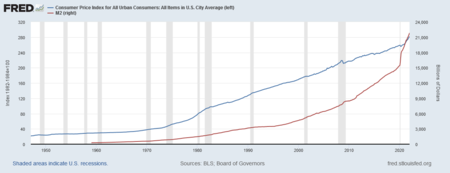
CPI-Urban (blueish) vs M2 money supply (red); recessions in gray
- See likewise European Cardinal Depository financial institution for other approaches and a more global perspective.
Money is used as a medium of commutation, as a unit of measurement of account, and as a ready store of value. These unlike functions are associated with unlike empirical measures of the coin supply. There is no single "correct" measure of the money supply. Instead, in that location are several measures, classified along a spectrum or continuum between narrow and wide monetary aggregates. Narrow measures include only the most liquid assets: those almost hands used to spend (currency, checkable deposits). Broader measures add less liquid types of avails (certificates of deposit, etc.).
This continuum corresponds to the way that different types of money are more or less controlled by monetary policy. Narrow measures include those more directly affected and controlled by budgetary policy, whereas broader measures are less closely related to budgetary-policy deportment.[5] It is a matter of perennial debate every bit to whether narrower or broader versions of the money supply have a more anticipated link to nominal Gdp.
The different types of money are typically classified as "1000"due south. The "One thousand"s unremarkably range from M0 (narrowest) to M3 (broadest) but which "M"due south are actually focused on in policy formulation depends on the land's central bank. The typical layout for each of the "Grand"due south is as follows:
| Blazon of coin | M0 | MB | M1 | M2 | M3 | MZM |
|---|---|---|---|---|---|---|
| Notes and coins in apportionment (outside Federal Reserve Banks and the vaults of depository institutions) (currency) | ✓[15] | ✓ | ✓ | ✓ | ✓ | ✓ |
| Notes and coins in bank vaults (vault cash) | ✓ | |||||
| Federal Reserve Banking concern credit (required reserves and excess reserves not physically nowadays in banks) | ✓ | |||||
| Traveler's checks of non-banking company issuers | ✓ | ✓ | ✓ | ✓ | ||
| Demand deposits | ✓ | ✓ | ✓ | ✓ | ||
| Other checkable deposits (OCDs), which consist primarily of negotiable order of withdrawal (NOW) accounts at depository institutions and credit union share draft accounts. | ✓[16] | ✓ | ✓ | ✓ | ||
| Savings deposits | ✓[17] | ✓ | ✓ | ✓ | ||
| Time deposits less than $100,000 and coin-market deposit accounts for individuals | ✓ | ✓ | ||||
| Large time deposits, institutional money market funds, brusk-term repurchase and other larger liquid assets[18] | ✓ | |||||
| All coin market funds | ✓ |
- M0 : In some countries, such equally the United Kingdom, M0 includes bank reserves, and then M0 is referred to every bit the monetary base, or narrow coin.[19]
- MB: is referred to as the budgetary base or total currency.[15] This is the base from which other forms of coin (like checking deposits, listed beneath) are created and is traditionally the most liquid measure of the money supply.[20]
- M1: Bank reserves are not included in M1.
- M2: Represents M1 and "close substitutes" for M1.[21] M2 is a broader classification of money than M1. M2 is a central economic indicator used to forecast inflation.[22]
- M3: M2 plus large and long-term deposits. Since 2006, M3 is no longer published by the US cardinal bank.[23] All the same, at that place are however estimates produced by diverse private institutions.
- MZM: Money with goose egg maturity. It measures the supply of fiscal avails redeemable at par on demand. Velocity of MZM is historically a relatively accurate predictor of aggrandizement.[24] [25] [26]
The ratio of a pair of these measures, most often M2 / M0, is chosen the money multiplier.
Definitions of "money" [edit]
Eastern asia [edit]
Hong Kong SAR, Red china [edit]
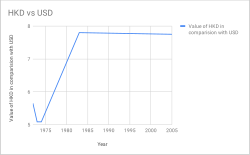
In 1967, when sterling was devalued, the Hong Kong dollar's peg to the pound was increased from 1 shilling 3 pence (£1 = HK$xvi) to i shilling 4½ pence (£ane = HK$fourteen.5455) although this did not entirely offset the devaluation of sterling relative to the Usa dollar (information technology went from US$1 = HK$five.71 to US$1 = HK$half dozen.06). In 1972 the Hong Kong dollar was pegged to the United states of america dollar at a charge per unit of US$1 = HK$v.65. This was reduced to HK$5.085 in 1973. Between 1974 and 1983 the Hong Kong dollar floated. On Oct 17, 1983, the currency was pegged at a charge per unit of US$1 = HK$7.fourscore through the currency board system.
As of May eighteen, 2005, in improver to the lower guaranteed limit, a new upper guaranteed limit was set for the [Hong Kong dollar at 7.75 to the American dollar. The lower limit was lowered from vii.eighty to 7.85 (by 100 pips per calendar week from May 23 to June twenty, 2005). The Hong Kong Monetary Authority indicated that this motion was to narrow the gap betwixt the interest rates in Hong Kong and those of the United States. A further aim of allowing the Hong Kong dollar to trade in a range is to avert the HK dollar beingness used as a proxy for speculative bets on a renminbi revaluation.
The Hong Kong Basic Law and the Sino-British Articulation Declaration provides that Hong Kong retains full autonomy with respect to currency issuance. Currency in Hong Kong is issued by the authorities and three local banks under the supervision of the territory'due south de facto central bank, the Hong Kong Budgetary Say-so. Bank notes are printed past Hong Kong Note Printing.
A banking company tin issue a Hong Kong dollar but if it has the equivalent exchange in The states dollars on eolith. The currency board system ensures that Hong Kong'due south entire budgetary base is backed with The states dollars at the linked exchange rate. The resources for the backing are kept in Hong Kong'due south substitution fund, which is among the largest official reserves in the world. Hong Kong also has huge deposits of US dollars, with official foreign currency reserves of 331.3 billion USD equally of September 2014[update].[27]
Japan [edit]

Japanese money supply (April 1998 – Apr 2008)
The Banking company of Japan defines the monetary aggregates as:[28]
- M1: cash currency in circulation, plus deposit money
- M2 + CDs: M1 plus quasi-money and CDs
- M3 + CDs: M2 + CDs plus deposits of post offices; other savings and deposits with financial institutions; and coin trusts
- Broadly divers liquidity: M3 and CDs, plus money market, pecuniary trusts other than money trusts, investment trusts, bank debentures, commercial newspaper issued by financial institutions, repurchase agreements and securities lending with cash collateral, government bonds and foreign bonds
Europe [edit]
United Kingdom [edit]

At that place are just 2 official Uk measures. M0 is referred to as the "wide monetary base" or "narrow money" and M4 is referred to as "broad money" or but "the money supply".
- M0: Notes and coin in circulation plus banks' reserve balance with Bank of England. (When the bank introduced Coin Market Reform in May 2006, the bank ceased publication of M0 and instead began publishing series for reserve balances at the Bank of England to back-trail notes and coin in circulation.[29])
- M4: Cash outside banks (i.e. in circulation with the public and non-bank firms) plus private-sector retail bank and edifice social club deposits plus private-sector wholesale banking company and building society deposits and certificates of deposit.[30] In 2010 the full money supply (M4) measure in the Uk was £2.2 trillion while the bodily notes and coins in apportionment totalled just £47 billion, 2.1% of the bodily money supply.[31]
There are several different definitions of coin supply to reverberate the differing stores of coin. Attributable to the nature of banking company deposits, especially time-restricted savings account deposits, M4 represents the virtually illiquid mensurate of money. M0, by dissimilarity, is the nearly liquid measure of the coin supply.
Eurozone [edit]

The euro money supplies M0, M1, M2 and M3, and euro zone GDP from 1980–2021. Logarithmic scale.
The European Central Bank's definition of euro area budgetary aggregates:[32]
- M1: Currency in circulation plus overnight deposits
- M2: M1 plus deposits with an agreed maturity upwardly to two years plus deposits redeemable at a period of notice upwards to three months.
- M3: M2 plus repurchase agreements plus money market place fund (MMF) shares/units, plus debt securities up to two years
North America [edit]
U.s. [edit]

MB, M1 and M2 from 1959 to 2021 (all shown in billions) Link. Note that before April 24, 2020 savings accounts were non part of M1[33]

M0, M1 and M3. US-Gross domestic product and M3 of Eurozone for comparison. Logarithmic scale.
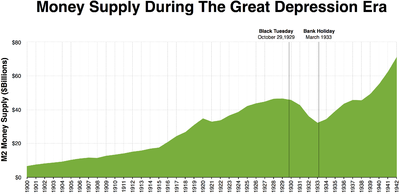

The United states of america Federal Reserve published data on 3 monetary aggregates until 2006, when it ceased publication of M3 data[23] and only published data on M1 and M2. M1 consists of money commonly used for payment, basically currency in circulation and checking account balances; and M2 includes M1 plus balances that mostly are like to transaction accounts and that, for the most part, can be converted fairly readily to M1 with picayune or no loss of principal. The M2 measure is thought to exist held primarily by households. Prior to its discontinuation, M3 comprised M2 plus certain accounts that are held by entities other than individuals and are issued by banks and thrift institutions to broaden M2-type balances in meeting credit demands, besides as balances in coin market common funds held by institutional investors. The aggregates have had different roles in budgetary policy equally their reliability as guides has changed. The principal components are:[34]
- M0: The total of all physical currency including coinage. M0 = Federal Reserve Notes + US Notes + Coins. It is not relevant whether the currency is held inside or outside of the private cyberbanking system as reserves.
- MB: The total of all physical currency plus Federal Reserve Deposits (special deposits that only banks can have at the Fed). MB = Coins + US Notes + Federal Reserve Notes + Federal Reserve Deposits
- M1: The total corporeality of M0 (cash/coin) outside of the individual cyberbanking system[ clarification needed ] plus the amount of demand deposits, travelers checks and other checkable deposits + about savings accounts.
- M2: M1 + money market accounts, retail money market place mutual funds, and minor denomination time deposits (certificates of deposit of under $100,000).
- MZM: 'Money Zip Maturity' is 1 of the most popular aggregates in use by the Fed because its velocity has historically been the most accurate predictor of inflation. Information technology is M2 – time deposits + money market funds
- M3: M2 + all other CDs (large time deposits, institutional coin market mutual fund balances), deposits of eurodollars and repurchase agreements.
- M4-: M3 + Commercial Paper
- M4: M4- + T-Bills (or M3 + Commercial Paper + T-Bills)
- L: The broadest mensurate of liquidity, that the Federal Reserve no longer tracks. L is very close to M4 + Bankers' Acceptance
- Money Multiplier: M1 / MB. As of December 3, 2015, it was 0.756.[35] While a multiplier under one is historically an oddity, this is a reflection of the popularity of M2 over M1 and the massive amount of MB the authorities has created since 2008.
Prior to 2020, savings accounts were counted as M2 and not function of M1 every bit they were non considered "transaction accounts" by the Fed. (There was a limit of half dozen transactions per wheel that could be carried out in a savings business relationship without incurring a penalisation.) On March 15, 2020, the Federal Reserve eliminated reserve requirements for all depository institutions and rendered the regulatory distinction betwixt reservable "transaction accounts" and nonreservable "savings deposits" unnecessary. On April 24, 2020, the Board removed this regulatory distinction by deleting the six-per-calendar month transfer limit on savings deposits. From this point on, savings business relationship deposits were included in M1.[17]
Although the Treasury can and does concur cash and a special eolith account at the Fed (TGA account), these assets do not count in any of the aggregates. Then in essence, money paid in taxes paid to the Federal Government (Treasury) is excluded from the money supply. To counter this, the regime created the Treasury Revenue enhancement and Loan (TT&Fifty) program in which any receipts above a certain threshold are redeposited in private banks. The idea is that tax receipts won't decrease the corporeality of reserves in the banking organisation. The TT&L accounts, while need deposits, do not count toward M1 or any other aggregate either.
When the Federal Reserve announced in 2005 that they would cease publishing M3 statistics in March 2006, they explained that M3 did non convey whatever additional information about economic activity compared to M2, and thus, "has not played a role in the monetary policy process for many years." Therefore, the costs to collect M3 information outweighed the benefits the data provided.[23] Some politicians have spoken out against the Federal Reserve's conclusion to finish publishing M3 statistics and take urged the U.South. Congress to take steps requiring the Federal Reserve to do and then. Congressman Ron Paul (R-TX) claimed that "M3 is the best description of how quickly the Fed is creating new money and credit. Common sense tells us that a authorities cardinal bank creating new money out of sparse air depreciates the value of each dollar in apportionment."[36] Modernistic Budgetary Theory disagrees. It holds that money creation in a free-floating fiat currency regime such as the U.S. volition non pb to significant inflation unless the economy is approaching full employment and full capacity. Some of the information used to calculate M3 are even so collected and published on a regular basis.[23] Current alternate sources of M3 data are available from the private sector.[37]
Every bit of April 2013, the monetary base was $three trillion[38] and M2, the broadest measure out of coin supply, was $10.5 trillion.[39]
Oceania [edit]
Commonwealth of australia [edit]

The coin supply of Commonwealth of australia 1984–2016
The Reserve Banking concern of Commonwealth of australia defines the monetary aggregates as:[40]
- M1: currency in circulation plus bank electric current deposits from the individual non-bank sector
- M3: M1 plus all other depository financial institution deposits from the private non-banking company sector, plus bank certificate of deposits, less inter-banking company deposits
- Broad money: M3 plus borrowings from the private sector past NBFIs, less the latter's holdings of currency and depository financial institution deposits
- Coin base: holdings of notes and coins by the private sector plus deposits of banks with the Reserve Bank of Australia (RBA) and other RBA liabilities to the individual non-bank sector.
New Zealand [edit]

The Reserve Bank of New Zealand defines the budgetary aggregates as:[41]
- M1: notes and coins held by the public plus chequeable deposits, minus inter-institutional chequeable deposits, and minus central government deposits
- M2: M1 + all non-M1 telephone call funding (call funding includes overnight money and funding on terms that can of right be broken without break penalties) minus inter-institutional non-M1 call funding
- M3: the broadest monetary amass. Information technology represents all New Zealand dollar funding of M3 institutions and any Reserve Bank repos with non-M3 institutions. M3 consists of notes & coin held by the public plus NZ dollar funding minus inter-M3 institutional claims and minus fundamental government deposits
Southern asia [edit]
India [edit]

Components of the money supply of India in billions of Rupee for 1950–2011
The Reserve Banking company of Bharat defines the monetary aggregates every bit:[42]
- Reserve coin (M0): Currency in circulation, plus bankers' deposits with the RBI and 'other' deposits with the RBI. Calculated from net RBI credit to the authorities plus RBI credit to the commercial sector, plus RBI'due south claims on banks and net foreign assets plus the government'south currency liabilities to the public, less the RBI's cyberspace non-monetary liabilities. M0 outstanding was ₹30.297 trillion equally on March 31, 2020.
- M1: Currency with the public plus deposit coin of the public (demand deposits with the cyberbanking system and 'other' deposits with the RBI). M1 was 184 per cent of M0 in Baronial 2017.
- M2: M1 plus savings deposits with post function savings banks. M2 was 879 per cent of M0 in August 2017.
- M3 (the broad concept of money supply): M1 plus fourth dimension deposits with the cyberbanking system, fabricated upwardly of net depository financial institution credit to the government plus banking concern credit to the commercial sector, plus the cyberspace strange exchange assets of the banking sector and the government's currency liabilities to the public, less the net non-budgetary liabilities of the banking sector (other than fourth dimension deposits). M3 was 555 per cent of M0 as on March 31, 2020(i.e. ₹167.99 trillion.)
- M4: M3 plus all deposits with postal service office savings banks (excluding National Savings Certificates).
[43]
Link with aggrandizement [edit]
Monetary exchange equation [edit]
The coin supply is of import because it is linked to inflation by the equation of substitution in an equation proposed by Irving Fisher in 1911:[44]

where
In mathematical terms, this equation is an identity which is true past definition rather than describing economical behavior. That is, velocity is defined by the values of the other three variables. Unlike the other terms, the velocity of money has no contained measure out and tin can only exist estimated by dividing PQ by M. Some adherents of the quantity theory of money presume that the velocity of money is stable and predictable, being determined by and large by financial institutions. If that supposition is valid then changes in Chiliad tin can exist used to predict changes in PQ. If not, then a model of 5 is required in gild for the equation of exchange to be useful as a macroeconomics model or every bit a predictor of prices.
Most macroeconomists supervene upon the equation of substitution with equations for the demand for coin which describe more regular and predictable economic beliefs. However, predictability (or the lack thereof) of the velocity of coin is equivalent to predictability (or the lack thereof) of the demand for money (since in equilibrium real money demand is simply Q / Five ). Either way, this unpredictability fabricated policy-makers at the Federal Reserve rely less on the money supply in steering the U.S. economy. Instead, the policy focus has shifted to interest rates such as the fed funds rate.
In practice, macroeconomists well-nigh ever use real Gdp to ascertain Q, omitting the office of all transactions except for those involving newly produced appurtenances and services (i.e., consumption goods, investment goods, government-purchased appurtenances, and exports). Merely the original quantity theory of money did not follow this practice: PQ was the monetary value of all new transactions, whether of real goods and services or of paper assets.

The monetary value of avails, appurtenances, and services sold during the year could be grossly estimated using nominal GDP back in the 1960s. This is not the case anymore because of the dramatic ascension of the number of financial transactions relative to that of real transactions up until 2008. That is, the full value of transactions (including purchases of newspaper avails) rose relative to nominal GDP (which excludes those purchases).
Ignoring the furnishings of monetary growth on existent purchases and velocity, this suggests that the growth of the coin supply may cause different kinds of inflation at different times. For case, rises in the U.South. money supplies between the 1970s and the present encouraged start a rise in the aggrandizement charge per unit for newly-produced goods and services ("inflation" as normally divers) in the 1970s and then asset-price inflation in later decades: information technology may have encouraged a stock market boom in the 1980s and 1990s and then, after 2001, a rise in home prices, i.e., the famous housing chimera. This story, of course, assumes that the amounts of money were the causes of these dissimilar types of inflation rather than existence endogenous results of the economy'south dynamics.
When home prices went down, the Federal Reserve kept its loose monetary policy and lowered interest rates; the attempt to wearisome price declines in ane asset class, eastward.g. real estate, may well accept acquired prices in other asset classes to rise, e.g. bolt.[ commendation needed ]
Rates of growth [edit]
In terms of percent changes (to a shut approximation, nether low growth rates),[45] the percentage change in a product, say XY, is equal to the sum of the percentage changes %Δ10 + %ΔY ). And then, cogent all percentage changes as per unit of time,
- %ΔP + %ΔQ = %ΔM + %ΔV
This equation rearranged gives the basic inflation identity:
- %ΔP = %ΔM + %ΔV – %ΔQ
Aggrandizement (%ΔP) is equal to the rate of money growth (%ΔChiliad), plus the alter in velocity (%ΔV), minus the rate of output growth (%ΔQ).[46] So if in the long run the growth rate of velocity and the growth rate of existent Gdp are exogenous constants (the former being dictated past changes in payment institutions and the latter dictated by the growth in the economy's productive capacity), then the monetary growth charge per unit and the aggrandizement rate differ from each other past a fixed constant.
As earlier, this equation is only useful if %ΔV follows regular beliefs. It also loses usefulness if the central bank lacks command over %Δ1000.
Arguments [edit]
Historically, in Europe, the main part of the central banking concern is to maintain depression aggrandizement. In the USA the focus is on both aggrandizement and unemployment.[ citation needed ] These goals are sometimes in conflict (co-ordinate to the Phillips curve). A fundamental bank may attempt to do this[ clarification needed ] by artificially influencing the demand for goods by increasing or decreasing the nation'southward money supply (relative to trend), which lowers or raises interest rates, which stimulates or restrains spending on appurtenances and services.
An important contend among economists in the 2d half of the 20th century concerned the central bank's power to predict how much money should exist in circulation, given current employment rates and inflation rates. Economists such as Milton Friedman believed that the central banking concern would always get information technology wrong, leading to wider swings in the economic system than if it were just left alone.[47] This is why they advocated a non-interventionist approach: one of targeting a pre-specified path for the money supply contained of current economic atmospheric condition, fifty-fifty though in exercise this might involve regular intervention with open market operations (or other monetary-policy tools) to keep the coin supply on target.
The erstwhile Chairman of the US Federal Reserve, Ben Bernanke, suggested in 2004 that over the preceding x to 15 years, many modernistic primal banks became relatively skilful at manipulation of the money supply, leading to a smoother business cycle, with recessions disposed to be smaller and less frequent than in earlier decades, a miracle termed "The Keen Moderation"[48] This theory encountered criticism during the global fiscal crisis of 2008–2009.[ citation needed ] Furthermore, it may exist that the functions of the primal bank demand to cover more than the shifting upwards or down of interest rates or depository financial institution reserves:[ citation needed ] these tools, although valuable, may non in fact moderate the volatility of money supply (or its velocity).[ citation needed ]
Impact of digital currencies and possible transition to a cashless society [edit]
See likewise [edit]
- A Program for Budgetary Reform
- American Monetary Institute
- Depository financial institution regulation
- Capital requirement
- Central banking company
- Chartalism
- Chicago plan
- The Chicago Programme Revisited
- Committee on Monetary and Economic Reform
- Core inflation
- Debt levels and flows
- Economic science terminology that differs from mutual usage
- Fiat currency
- Financial capital
- Float
- Partial-reserve banking
- FRED (Federal Reserve Economical Data)
- Full reserve banking
- Nifty Wrinkle
- Index of Leading Indicators – coin supply is a component
- Inflation
- Monetarism
- Monetary base
- Budgetary economics
- Monetary reform
- Money apportionment
- Money creation
- Coin marketplace
- Money demand
- Liquidity preference
- Seigniorage
- Stagflation
References [edit]
- ^ Alan Deardorff. "Money supply," Deardorff'south Glossary of International Economics
- ^ Karl Brunner, "coin supply," The New Palgrave: A Dictionary of Economic science, 5. 3, p. 527.
- ^ The Coin Supply – Federal Reserve Depository financial institution of New York. Newyorkfed.org.
- ^ Milton Friedman (1987). "quantity theory of coin", The New Palgrave: A Lexicon of Economics, five. four, pp. 15–19.
- ^ a b "money supply Definition". Retrieved July 20, 2008.
- ^ McLeay, Michael. "Money Creation in the Modern Economy" (PDF). Banking concern of England.
- ^ "The coexistence of central and commercial banking concern monies: multiple issuers, one currency". The Role of Central Banking concern Money in Payment Systems (PDF). Bank for International Settlements. p. 9.
- ^ The Office of Central Bank Money in Payment Systems (PDF). Bank for International Settlements. p. 3.
Contemporary monetary systems are based on the mutually reinforcing roles of central banking company coin and commercial banking concern monies.
- ^ Domestic payments in Euroland: commercial and cardinal bank money. European Central Bank. November nine, 2000.
At the beginning of the 20th almost the totality of retail payments were made in cardinal banking company money. Over fourth dimension, this monopoly came to exist shared with commercial banks, when deposits and their transfer via checks and giros became widely accepted. Banknotes and commercial bank money became fully interchangeable payment media that customers could use co-ordinate to their needs. While transaction costs in commercial banking company coin were shrinking, cashless payment instruments became increasingly used, at the expense of banknotes.
- ^ 12 C.F.R. sec. 204.ii(k).
- ^ 12 C.F.R. sec. 204.5(a).
- ^ What is vault greenbacks? definition and meaning. Investorwords.com.
- ^ "Net Free or Borrowed Reserves of Depository Institutions (NFORBRES) – FRED". research.stlouisfed.org. St. Louis Fed. January 1929. .
- ^ Boermans, Martijn; Moore, Basil (2009). Locked-in and Sticky textbooks. Issuu.com.
- ^ a b "Gilded, Oil, Stocks, Investments, Currencies, and the Federal Reserve: Growth of Global Money Supply" Archived September 15, 2015, at the Wayback Car. DollarDaze Economic Commentary Weblog past Mike Hewitt.
- ^ M1 Money Stock (M1) – FRED – St. Louis Fed. Enquiry.stlouisfed.org.
- ^ a b "Revisions to the H.six Statistical Release". December 17, 2020.
{{cite web}}: CS1 maint: url-condition (link) - ^ M3 Definition. Investopedia (February fifteen, 2009).
- ^ M0 (monetary base of operations). Moneyterms.co.united kingdom of great britain and northern ireland.
- ^ "M0". Investopedia. Archived from the original on March 30, 2018. Retrieved July 20, 2008.
- ^ "M2". Investopedia. Retrieved July 20, 2008.
- ^ "M2 Definition". InvestorWords.com. Archived from the original on July 13, 2008. Retrieved July 20, 2008.
- ^ a b c d Discontinuance of M3, Federal Reserve, November 10, 2005, revised March 9, 2006.
- ^ Aziz, John (March 10, 2013). "Is Aggrandizement Ever And Everywhere a Monetary Phenomenon?". Azizonomics . Retrieved April two, 2013.
- ^ Thayer, Gary (January sixteen, 2013). "Investors should presume that inflation will exceed the Fed's target". Macro Strategy. Wells Fargo Advisors. Archived from the original on July fourteen, 2014. Retrieved April two, 2013.
- ^ Carlson, John B.; Benjamin D. Bully (1996). "MZM: A monetary aggregate for the 1990s?" (PDF). Economical Review. Federal Reserve Depository financial institution of Cleveland. 32 (ii): 15–23. Archived from the original (PDF) on September 4, 2012. Retrieved April 2, 2013.
- ^ "Hong Kong's Latest Strange Currency Reserve Avails Figures Released". Hong Kong Monetary Authority. Retrieved Nov xx, 2016.
- ^ (PDF). Bank of Nihon. p. 11 http://www.boj.or.jp/en/type/exp/stat/information/exms01.pdf.
- ^ "Further details about M0 data". Bank of England. Nov 8, 2018.
- ^ "Explanatory Notes – M4". Depository financial institution of England. Archived from the original on August 9, 2007. Retrieved August thirteen, 2007.
- ^ Lipsey, Richard G.; Chrystal, K. Alec (2011). Economics (12th ed.). Oxford University Press. p. 455. ISBN978-0199563388.
- ^ "Monetary aggregates". European Cardinal Banking concern. Retrieved Nov 20, 2016.
- ^ "Savings are now more liquid and part of "M1 money"". St. Louis Federal Reserve Banking company.
- ^ "The Federal Reserve – Purposes and Functions" . Federalreserve.gov. Apr 24, 2013. Retrieved December 11, 2013.
- ^ "M1 Coin Multiplier". enquiry.stlouisfed.org. Feb 15, 1984. Retrieved December 3, 2015.
- ^ What the Price of Gold Is Telling Us. Lewrockwell.com (April 25, 2006).
- ^ "Alternate data". Shadowstats.com.
- ^ "Aggregate Reserves of Depository Institutions and the Monetary Base – H.three". Federal Reserve. Archived from the original on June sixteen, 2013.
- ^ "H.vi Coin Stock Measures". Federal Reserve Statistical Release. Federal Reserve. Archived from the original on June 16, 2013.
- ^ "Glossary". Reserve Bank of Australia. November 11, 2015.
- ^ Series description – Monetary and financial statistics. Rbnz.govt.nz.
- ^ "Notes on Tables". Handbook of Statistics on Indian Economy (PDF). p. 4.
- ^ "Press Releases of Reserve Banking company of Republic of india on 16 Dec 2020".
- ^ The Purchasing Power of Money, its Determination and Relation to Credit, Interest and Crises, Irving Fisher.
- ^ "Percentage Change Approximation". Archived from the original on July 24, 2012.
- ^ "Breaking Budgetary Policy into Pieces". May 24, 2004.
- ^ Milton Friedman (1962). Capitalism and Freedom .
- ^ Speech, Bernanke – The Peachy Moderation. Federal Reserve Depository financial institution (February xx, 2004).
Further reading [edit]
- Article in the New Palgrave on Money Supply by Milton Friedman
- Practice all banks hold reserves, and, if so, where do they hold them? (11/2001)
- What effect does a change in the reserve requirement accept on the money supply? (08/2001)
- St. Louis Fed: Monetary Aggregates
- Hülsmann, Jörg (2008). The Ethics of Money Product. Auburn, Alabama: Ludwig von Mises Establish. p. 294. ISBN9781933550091.
- Discontinuance of M3 Publication
- Investopedia: Money Zero Maturity (MZM)
External links [edit]
- Aggregate Reserves Of Depository Institutions And The Budgetary Base (H.3)
- Historical H.3 releases
- Money Stock Measures (H.six)
- U.S. MZM magnitude and velocity, used every bit a predictor of inflation
- Information on Budgetary Aggregates in Australia
- Monetary Statistics on Hong Kong Budgetary Say-so
- Monetary Survey from People's Bank of China
Source: https://en.wikipedia.org/wiki/Money_supply
0 Response to "what is the term to describe buying items today rather than saving the money?"
Post a Comment